The tools that would free up my time in my role don't exist as a standalone SAAS product. Not because they're technically hard, but because no company would ever build and market them. The market size is literally one person.
For it to be effective, I need a tool that knows my Thursday leadership company update starts at 10am and that I present metrics in a specific format. Or a tool that can look at my actual calendar and to-do list and tell me what actually matters today - not generically, but given what I'm working on right now and the business priorities.
Some of this you can now with the newer batch of AI tools, but its manual and on-demand. The value I'm getting from these micro-tools is that the work is done, is there and ready, before I've opened my laptop. It's both saving time, and reducing the cognitive load of thinking about the task.
Micro-tool 1: Daily Focus
Before building this, I'd spend up to 25 minutes each morning prioritising my day to maximise my time. I'd review my Google Calendar, my task list in Things3, and map it to my high-level priorities, which typically live in my head.
Now, at 7am, an iOS Shortcut pulls my tasks from Things3 on my device and posts them to a Google Apps Script webhook. The script fetches my calendar, sends both to Claude, and emails me a daily focus list: what meetings I have, where the gaps are, what to prioritise, and what can wait.
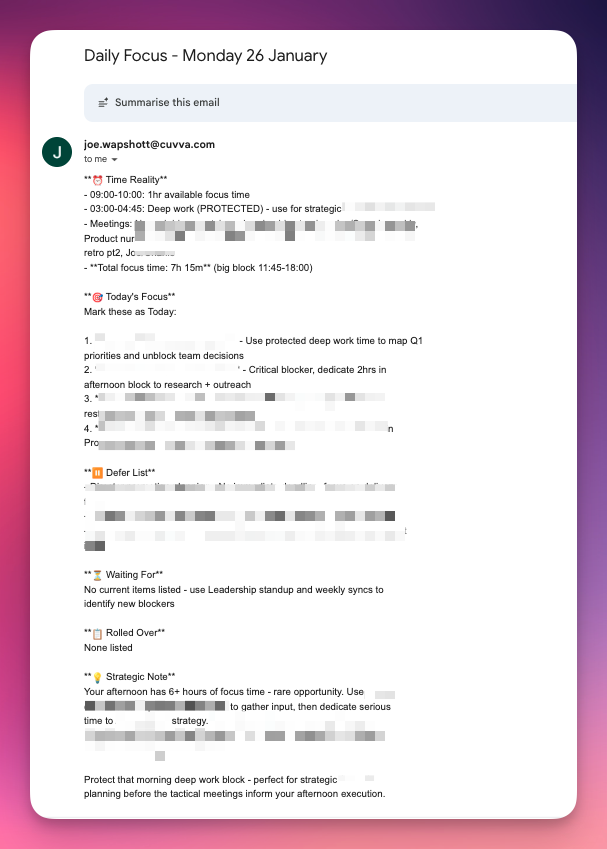
I still spend a few minutes adjusting things; a conversation may have happened very recently that changed priorities, but this is refining a priority focus that is 95% there.
Micro-tool 2: Leadership Brief
Every Thursday at 10am, I present an update on performance to the whole company. We use Looker as the data suite, and I run through a specific report. The structure of my update is always the same - only the numbers / context change. Before building this tool, I'd typically spend 20 minutes pulling out figures and formatting them into my template to make sure there's value for each of the team members on the call.
Now, a Google Apps Script runs every Thursday at 7:15am. It finds an auto-generated Looker PDF in my Gmail with the report, sends it to Claude with my brief template, and prepends a draft to a running Google Doc. Previous weeks stay below in the doc, so I can refer back to them if required.
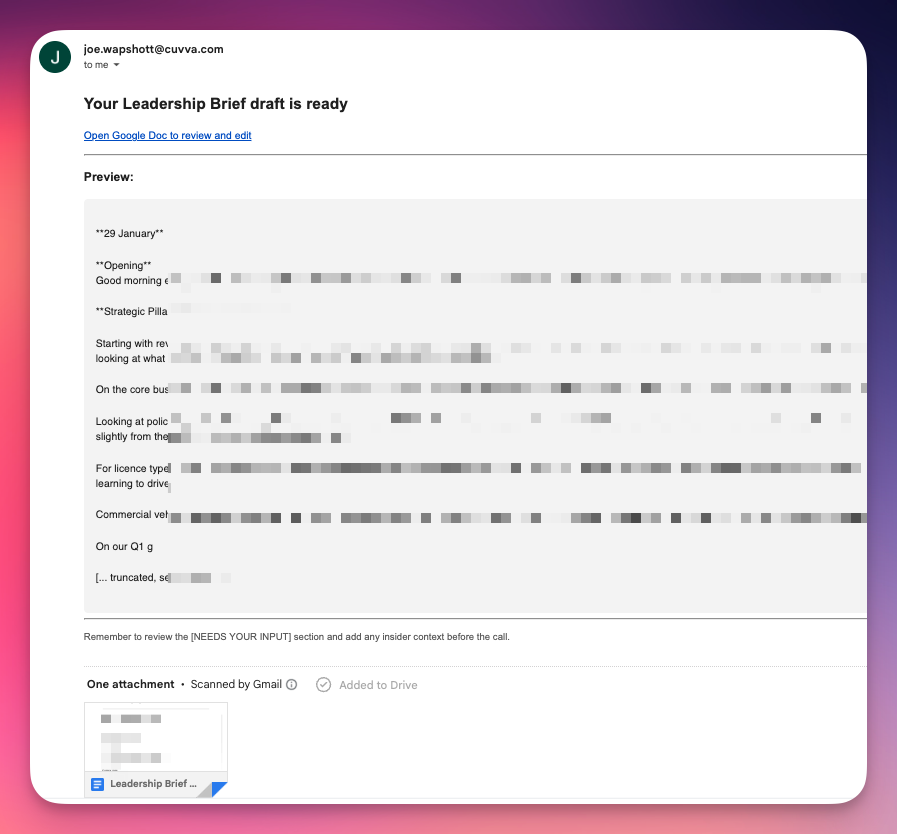
By the time I open my laptop, the draft is waiting, and I can repurpose that prep time to other high value work.
Micro-tool 3: Meeting Actions
Like a lot of G-Suite users in 2026, we use Gemini for meeting transcripts. It's got a lot better over the last 12 months and captures suggested actions and next steps attributed to each person on a call, based on who was speaking. In theory, useful. In practice, with lots of calls each day these emails sat in my inbox and I'd rarely extract my actions. Tasks would inevitably slip.
Now, a Google Apps Script runs every 15 minutes in the working week, checking for new transcripts. It sends the content to Claude to extract actions assigned to me, then emails each one to my Things 3 to-do list app.
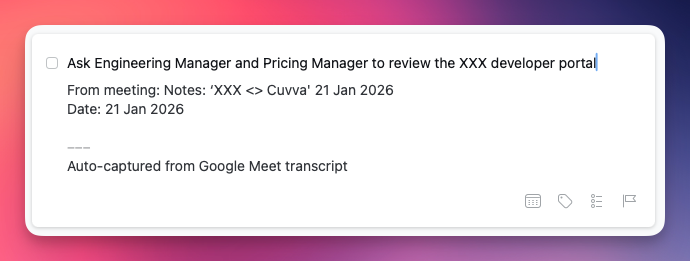
The actions aren't always perfectly worded - sometimes I'll edit the task title to make it clearer. But the gap between "I said I'd do this" and "it's now ready to be prioritised with context on my to-do list" has closed completely.
The pattern
These tools are simple. They all share the same architecture: email as input, Google Apps Script as orchestration, Claude API for the thinking, and output to wherever I actually work.
They also share the same key principles:
Hyper-personalised. These tools know my meeting schedule, my to-do list app, my reporting format, and my name as it appears in transcripts. That specificity is what makes them useful - and it also means they'll never be commercial products.
Augmentation, not automation. The tools do the grunt work. I still make the calls.
Cheap to build. Each one took an afternoon with Claude Code. Apps Script is free. Claude API costs pennies. The barrier was recognising I could build the thing myself.
What I've noticed after a few weeks
The time saving is real - around four hours a week across the three tools. But there's also a mental load reduction, where the grunt work is picked up.
I've also noticed that building these has changed how I look at other friction in my work. When something is annoying, my first thought is now "could I build something to fix this?" rather than "I wish there was a tool for this."
The cost of building bespoke solutions is close to free now. The tools that would make you better at your job probably don't exist either. But now you can just build them.